


Customer racing has always carried a significant barrier to entry. Beyond the cost of purchasing a vehicle, transforming a production car into a reliable and safe race car requires substantial investment in suspension, braking, safety equipment, cooling systems, and ongoing maintenance. Roll cages, racing seats, harnesses, fire suppression systems, and motorsport electronics quickly add cost, while extensive modifications often compromise the practicality that made the original road car appealing in the first place.
BMW M Motorsport developed the all-new G87 M2 Racing to address many of these challenges. Rather than requiring customers to build a race car from a production vehicle, the M2 Racing arrives from the factory as a purpose-built competition platform engineered specifically for track use. Safety systems, cooling solutions, motorsport electronics, and chassis enhancements are integrated from the beginning, reducing development time while delivering the durability and reliability required for competitive racing.
Positioned as an accessible entry point into customer motorsport, the M2 Racing combines proven BMW M driving dynamics with lower operating costs and simplified serviceability. The result is a factory-supported race car designed to help private teams and amateur drivers focus on racing rather than development.
"The new BMW M2 Racing is affordable and offers race teams and drivers uncompromising performance, durability, and driving pleasure. At BMW M Motorsport, supporting customer racing with race cars that are maintenance-friendly, cost-efficient, and exciting to drive is of high importance."
Franciscus van Meel
CEO, BMW M GmbH
Source: BMW M Motorsport - BMW M2 Racing
Why BMW M Chose the B48 Instead of the S58
Perhaps the most debated aspect of the BMW M2 Racing program is BMW M Motorsport's decision to utilize the B48 turbocharged four-cylinder engine rather than the S58 twin-turbo inline-six found in the road-going G87 M2. While some enthusiasts initially questioned the move, a closer look at the objectives of the M2 Racing program reveals a very deliberate engineering decision.
The M2 Racing was never intended to replace BMW's GT4 platform or serve as a higher-horsepower alternative to existing professional customer racing programs. Instead, BMW M Motorsport developed the car as an accessible entry point into competitive racing where operating costs, reliability, serviceability, and class eligibility were prioritized alongside performance.
Compared to the S58, the B48 offers several advantages for a customer racing platform. The engine is less expensive to manufacture, maintain, and replace, helping reduce overall running costs throughout a racing season. The lighter four-cylinder configuration also removes weight from the front axle, improving turn-in response, weight distribution, tire wear, and braking performance. These benefits become increasingly important in endurance racing and customer racing environments where consistency and durability often outweigh outright power.
Another advantage of the B48 platform is its compatibility with a broader range of racing categories around the world. By utilizing a turbocharged 2.0-liter four-cylinder engine, BMW M Motorsport created a package that can more easily fit within the regulations of various national and international racing series, expanding the potential customer base and increasing opportunities for competition.
BMW M2 Racing: Technical Highlights
The BMW G87 M2 Racing program was developed with a singular goal: to deliver a purpose-built customer race car that combines durability, performance, safety, and cost-effective operation. Rather than relying solely on in-house components, BMW M Motorsport partnered with some of the most respected names in professional motorsport to engineer a platform capable of handling the demands of wheel-to-wheel competition while remaining accessible to private teams and amateur racers.
One of the most significant partnerships within the M2 Racing program is with KW Automotive. With more than three decades of experience developing suspension systems for both OEM manufacturers and professional racing programs, KW has become one of the most trusted names in vehicle dynamics and chassis development.
While many enthusiasts recognize KW for its aftermarket suspension products, the company is also deeply involved in OEM and motorsport engineering projects around the world. Supporting that development process is KW's in-house 7-post driving dynamics test rig, an advanced hydraulic simulation system capable of replicating real-world track conditions in a controlled environment. This technology allows engineers to evaluate suspension behavior, wheel loads, damping characteristics, and overall vehicle dynamics using the same testing methods employed by top-tier motorsport teams and automotive manufacturers.

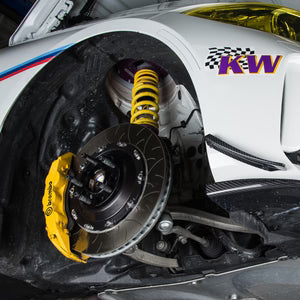
Working directly with BMW M Motorsport, KW utilized vehicle-specific engineering data throughout the development process to design and validate the suspension package found on the M2 Racing. The result is a system built around KW dampers derived from the company's latest GT3 racing technology, paired with adjustable front and rear anti-roll bars that allow teams to fine-tune chassis balance for different circuits, weather conditions, and driver preferences.

Safety Systems Designed for Competition
Unlike a production vehicle modified for occasional track use, the BMW M2 Racing was engineered from the outset with motorsport safety as a primary consideration. Every major safety system has been integrated into the vehicle as part of the factory design, providing drivers with a platform built specifically for the demands of competitive racing.
At the center of the safety package is a DMSB-certified welded roll cage designed to meet modern motorsport safety requirements while significantly increasing chassis rigidity. Beyond occupant protection, the integrated cage structure contributes to overall vehicle stability and consistency under high cornering and braking loads.


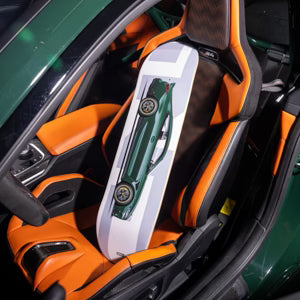
The cockpit is centered around a fixed-back Sabelt GT-AM racing seat designed specifically for competition use. BMW M Motorsport also offers an optional adjustable seat rail package, allowing teams to more easily accommodate multiple drivers. Driver restraint is handled through a Schroth racing harness system that works in conjunction with the seat and chassis structure to help secure the driver during high-load driving situations.


Additional safety equipment includes an integrated fire suppression system, electrical master cut-off switch, and an FT3-certified motorsport fuel cell. Unlike a conventional road car fuel tank, the FT3 fuel cell utilizes a reinforced bladder design intended to reduce the risk of fuel leakage during an impact while meeting modern motorsport safety standards.


Further occupant protection comes from the OMP side containment net mounted on the passenger side of the cockpit. As the M2 Racing is configured as a dedicated single-seat race car, the containment net occupies the area where a passenger seat would traditionally be located. Working alongside the Sabelt seat and Schroth harness system, the OMP net helps control driver movement during high-impact situations and provides an additional layer of protection during wheel-to-wheel competition.

The result is a comprehensive safety package that reflects BMW M Motorsport's commitment to customer racing, combining modern FIA-compliant safety equipment with the durability and functionality required for long-term competition use.
Wheels, Tires & Brake Cooling
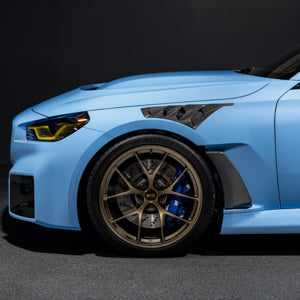
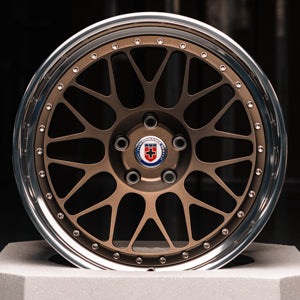
When it comes to motorsport engineering, bigger is not always better. While modern performance cars continue to trend toward larger wheel diameters, BMW M Motorsport took a different approach with the M2 Racing by selecting a purpose-built forged 18x10 square wheel package. Finished in matte black and featuring an ET3 offset, the wheel design prioritizes performance, durability, and serviceability rather than appearance alone.

Each wheel is paired with a 265/660 R18 racing tire, a combination chosen to deliver predictable handling characteristics, optimized tire wear, and lower operating costs throughout a race season. BMW M Motorsport also incorporated a knurled bead seat design into the wheel itself, helping reduce tire slip on the rim under heavy acceleration and braking loads. To further simplify wheel changes and improve reliability during competition use, the M2 Racing utilizes a factory M14 wheel stud conversion rather than traditional wheel bolts.


The decision to utilize an 18-inch wheel package mirrors a growing trend among track-focused G87 M2 owners, where smaller diameter wheels provide reduced weight, improved tire availability, and increased sidewall compliance compared to larger street-oriented wheel configurations. The same forged BMW Motorsport G87 M2 Racing 18x10 Wheel Set is available through IND, providing enthusiasts access to genuine BMW M Motorsport-developed wheel technology.
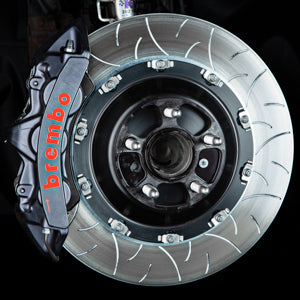
BMW M Motorsport devoted equal attention to brake cooling. The M2 Racing utilizes BMW M Motorsport-specific brake components with dedicated cooling provisions. Dedicated dual-feed brake cooling ducts are integrated directly into the front lower bumper assembly and route airflow toward the front brake assemblies, helping manage temperatures during prolonged track sessions and competitive racing conditions.


The system works in conjunction with motorsport-specific brake pads front and rear, creating a package designed to maintain braking consistency and reduce thermal stress under repeated heavy use. One of the most impressive engineering details found on the M2 Racing is how much emphasis BMW M placed on brake cooling and thermal management. It is an area we were particularly excited to see firsthand and one that has inspired future development plans for our own G87 M2 project as well as potential solutions for our customer base.

BMW M Motorsport Racing Exhaust System
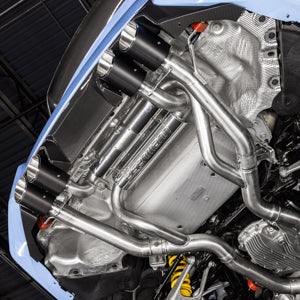
Despite utilizing the four-cylinder B48 engine, BMW M Motorsport retained a quad-exit exhaust layout that preserves the visual identity of the G87 chassis while incorporating a motorsport-specific exhaust system engineered for durability, serviceability, and weight reduction.
The system begins with a single exhaust path from the turbocharger before passing through a centrally mounted catalytic converter and resonator assembly. Unlike the road-going M2, the M2 Racing does not utilize a traditional rear muffler or large exhaust canister. Eliminating unnecessary components reduces weight and simplifies the exhaust flow path while maintaining the reliability required for endurance racing and long-term competition use.


While the primary focus of the system is performance and durability, BMW M Motorsport also had to consider noise restrictions imposed by racing circuits around the world. The inclusion of a catalytic converter and resonator allows the M2 Racing to comply with track-specific sound regulations without compromising the functionality expected from a dedicated customer race car.

The result is a lightweight, purpose-built exhaust system that balances performance, serviceability, and regulatory compliance while maintaining the unmistakable appearance of a modern BMW M race car.
Engine & Drivetrain
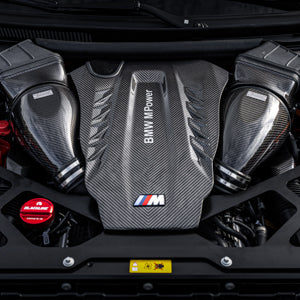
Power comes from a motorsport-prepared version of BMW's B48 engine producing 230 kW (313 horsepower) and 400 Nm of torque from its 1,998cc displacement. Combined with the reduced vehicle weight and race-focused chassis setup, the result is a package engineered around balance, consistency, and long-term reliability rather than headline horsepower figures.


Power is delivered through BMW M Motorsport's racing-calibrated ZF 8HP transmission. While based on the same proven transmission architecture found in many modern BMW M applications, the gearbox benefits from BMW M Motorsport software designed specifically for competition use, providing fast and reliable gear changes while maintaining the durability required for customer racing.

Motorsport-Focused Interior & Lightweight Engineering
Throughout the M2 Racing, BMW M Motorsport focused on reducing weight wherever possible while retaining the functionality required for competition use. One example can be found in the center console, where BMW incorporated the lightweight carbon fiber center console derived from the M2 CS program and adapted it for motorsport use.

Beyond the weight savings offered by the carbon fiber construction, the console has been modified with additional motorsport-specific controls and switchgear, creating a cleaner and more functional cockpit environment for race drivers. The result is a component that looks entirely at home within the purpose-built racing interior while contributing to the overall lightweight philosophy of the vehicle.


Additional attention to serviceability can be seen through the use of quick-release bonnet and trunk latches. These motorsport-style fasteners allow technicians and teams to rapidly access critical vehicle systems during inspections, maintenance, and race weekend repairs. While seemingly a small detail, these types of solutions highlight the practical engineering considerations that separate a dedicated race car from a modified road car.

The M2 Racing also incorporates a carbon fiber roof as part of BMW M Motorsport's comprehensive lightweighting strategy. By reducing weight at one of the highest points on the vehicle, the carbon roof helps lower the center of gravity, contributing to improved handling characteristics, chassis response, and overall vehicle dynamics during competition use.
Taken together, these lightweight and service-focused design elements demonstrate BMW M Motorsport's commitment to creating a race car that is not only competitive on track, but also efficient to operate and maintain throughout a demanding racing season.
Thermal Management & Differential Protection
While inspecting the BMW M2 Racing, one area we were particularly interested in was how BMW M Motorsport addressed heat management around the rear differential output shafts and CV boots. High temperatures generated by the differential, brakes, and surrounding drivetrain components can accelerate wear on rubber CV boots and related components, making thermal management an important consideration for any vehicle subjected to sustained track use.
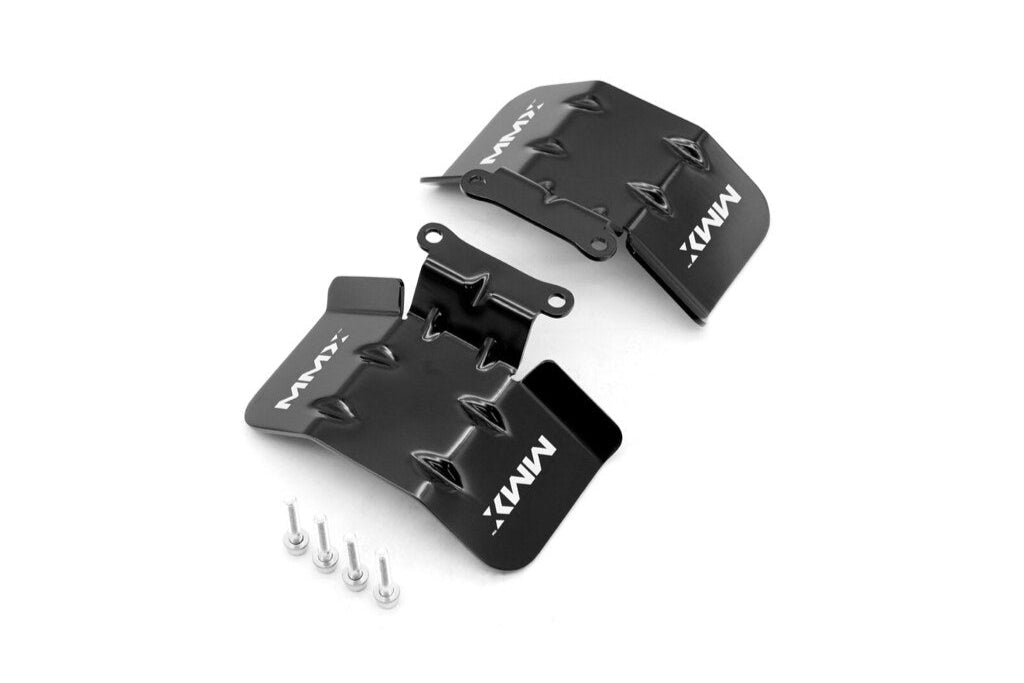
As expected, BMW M Motorsport recognized this area as a priority and incorporated dedicated heat shielding into the M2 Racing program. The solution is straightforward and functional, utilizing formed metal shields positioned to help reduce heat exposure to nearby drivetrain components. While relatively simple in execution, the fact that BMW M Motorsport specifically addressed this area further validates the importance of thermal protection for both race and track-driven G8X platforms.

For enthusiasts seeking a more robust solution, the MMX Performance G8X Rear Differential Output Shaft Heat Shield Set takes a more engineered approach. Manufactured from lightweight T6-6061 aluminum and utilizing dedicated mounting hardware, the MMX system was designed to provide secure installation while helping protect critical drivetrain components from excessive heat exposure. Seeing BMW M Motorsport devote attention to this area only reinforces the importance of proper thermal management on both street and track-focused G8X applications.


Areas We Identified for Improvement
One of the most interesting aspects of evaluating a factory race car is identifying where BMW M Motorsport focused its engineering resources and where opportunities still exist for further refinement. While the M2 Racing is an exceptionally well-developed platform, a few areas immediately stood out to us during our inspection.
Oil Cooler Protection
Just like the road-going G8X M2, M3, and M4 models, the M2 Racing retains the front-mounted oil cooler location. While the factory cooling system performs exceptionally well, the exposed location of the oil cooler leaves it vulnerable to debris, rubber pickup, and track hazards encountered during high-performance driving.
To add an additional layer of protection, we installed the Fall-Line Motorsports Oil Cooler Guard on Bob's M2 Racing. Constructed from stainless steel and developed through extensive track testing, the guard helps shield the factory oil cooler from debris while maintaining airflow to the cooling system. Designed and manufactured in Illinois, the Fall-Line solution has become one of our preferred upgrades for track-driven G8X applications.


Steering Wheel Ergonomics
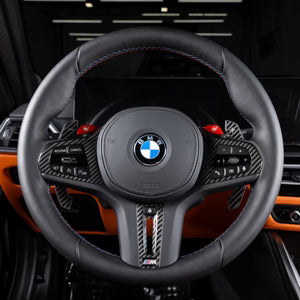
Another area that immediately caught our attention was the steering wheel. While fully functional and equipped with the controls required for competition use, the wheel itself is relatively large and does not feature a quick-release mechanism.
For a dedicated race car, a quick-release steering wheel can improve cockpit access, simplify driver changes, and enhance overall ergonomics. Recognizing this opportunity, we have begun working with the team at JQ Werks on the development of a quick-release steering wheel solution specifically for the M2 Racing platform. Development is currently underway, and we look forward to testing the system once prototypes become available.


Differential Cooling & Driveline Development
Through ongoing testing and development, we have observed that differential temperatures become an important consideration on heavily tracked G87 M2 applications. This is an area where BMW M Motorsport clearly invested significant engineering effort when developing the M2 Racing.
To improve durability under prolonged competition use, BMW equipped the M2 Racing with a larger finned differential housing, a mechanical differential lock, and a dedicated differential cooling system. Fresh air is supplied through a Makrolon rear side window featuring an integrated intake scoop, which directs airflow toward a dedicated rear-mounted differential cooler.

This approach directly addresses the thermal challenges often encountered on heavily tracked street vehicles and demonstrates the level of engineering BMW M Motorsport applied to long-term durability and driveline performance.

While the cooling system itself is an impressive upgrade, we saw an opportunity to further improve differential stability through the installation of the MMX Performance G8X Dual Differential Mount paired with the factory motorsport bushing.
Under hard acceleration, aggressive cornering, and repeated track use, the factory differential mounting system can allow unwanted movement within the drivetrain. This movement can affect traction consistency, power delivery, and long-term component wear. The MMX solution increases mounting rigidity, reduces differential deflection, and improves overall driveline response.
By stabilizing the differential more effectively, the system helps improve driver feedback, maintain more consistent tire loading, and reduce the likelihood of differential and CV seal weeping associated with excessive movement. Manufactured from CNC-machined 6061-T6 billet aluminum, the MMX mount delivers exceptional strength while maintaining a lightweight profile, making it a natural complement to the extensive differential upgrades already incorporated into the M2 Racing platform.


Closing Thoughts

After spending time inspecting the BMW M2 Racing in detail, it becomes clear that BMW M Motorsport approached this program with a very specific objective. Rather than building the fastest or most powerful race car possible, BMW focused on creating a platform that delivers predictable performance, long-term durability, reduced operating costs, and accessibility for customer racing teams.
Throughout the vehicle, that philosophy is evident. From the KW suspension package and dedicated brake cooling system to the extensive safety equipment, differential cooling strategy, and service-focused engineering solutions, every component was selected with reliability and usability in mind. The result is a race car that allows drivers and teams to spend more time competing and less time developing or repairing the platform.
Perhaps the most interesting takeaway is how many lessons from the M2 Racing can be applied to the road-going G87 M2. Thermal management, brake cooling, differential stability, driveline protection, and lightweight engineering all remain critical considerations whether the vehicle is competing in a sanctioned race series or participating in regular track days.
For enthusiasts, the M2 Racing provides a unique look into BMW M Motorsport's engineering priorities. It shows exactly where the factory invests its resources when performance, durability, and safety are placed above marketing specifications and horsepower figures. In many ways, the M2 Racing serves as a blueprint for what a properly developed track-focused G87 can become.
As we continue developing our own G87 M2 projects and supporting customers around the world, many of the engineering solutions found on the M2 Racing will undoubtedly influence future product development and testing. Whether it is cooling, suspension, driveline stability, or safety, there is always something to learn from a factory-built race car developed by BMW M Motorsport.
The BMW M2 Racing represents far more than an entry-level race car. It is a factory-engineered motorsport platform that demonstrates BMW M Motorsport's approach to balancing performance, reliability, safety, serviceability, and operating costs. For enthusiasts and racers alike, it offers valuable insight into the engineering decisions that matter most when a vehicle is designed for competition from day one.


